On this page 10 sections
- Is there any clinical study of Geladjin Gummies?
- How strong is the evidence on apple cider vinegar?
- What does the research on ginger cover?
- What is the evidence ladder for Geladjin Gummies?
- What happened to the retracted vinegar trial?
- What would new evidence look like?
- What do supplement contents have to do with the science?
- Why do we keep saying "on its own"?
- How can you judge a research claim yourself?
- FAQ
The science behind Geladjin Gummies is thin: we found no study of the gummy itself, only research on vinegar and ginger on their own, one retracted vinegar trial and general guidance about evidence. This page lays out that evidence step by step so you can see where each claim stands.
Everything below comes from government, university and publisher sources we read on November 28, 2026. None of it tests Geladjin Gummies, and none of it tells you what the gummy will do.
Is there any clinical study of Geladjin Gummies?
No. We searched and found no clinical study, trial or published research on Geladjin Gummies, and the label cites none.
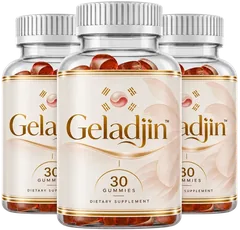
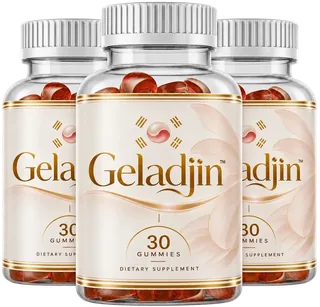
The label prints amounts and cautions only. It does not mention a study, a university or a trial, and it makes no claim about results. The sales page named in the owner pack did not load for us, so we could not check it for study references, and the affiliate page that read the order page, which we could not confirm ourselves, gives no study either1. We read that as an absence in what we could see, not as proof that none exists.
If you see a claim that Geladjin has been studied, ask for the citation: who ran the study, how many people, what was measured and whether it tested this product. A study of vinegar as a liquid is not a study of a gummy.
How strong is the evidence on apple cider vinegar?
It is weak. MedlinePlus says there is no good scientific evidence for obesity, diabetes, athletic performance or kidney stones, and not enough reliable information to say whether apple cider vinegar might be helpful2.
MedlinePlus also says there is not enough reliable information to set a medicinal dose2. That matters here, because it means no source we have gives a reliable amount to compare the gummy against, and we do not try.
Operation Supplement Safety says apple cider vinegar is marketed for appetite, weight, blood sugar, cholesterol, digestion and immunity, that the evidence for those is of low quality and that studies are small3. Read our apple cider vinegar guide for the ingredient itself.
| Item | What the sources say |
|---|---|
| Vinegar for weight or blood sugar | Not enough reliable evidence (MedlinePlus) |
| Ginger | Some evidence for nausea of pregnancy; no doses given for comparison (NCCIH) |
| Excess added sugar | Linked to weight gain, type 2 diabetes and heart disease (CDC, Harvard) |
| A 2024 vinegar trial | Retracted September 23, 2025 (BMJ Group) |
| Geladjin Gummies | No study found |
Research covers each ingredient alone, usually for other uses and at other amounts.
What does the research on ginger cover?
Ginger research covers other uses, not this product. NCCIH says research suggests ginger supplements may help nausea and vomiting of pregnancy, and might reduce menstrual cramp severity4.
The same page says most motion sickness studies have not shown help, that results are uncertain for nausea after chemotherapy or surgery, and that ginger might help knee osteoarthritis symptoms though much of that research is of poor quality4. It says ginger has been used safely by mouth in many studies, and lists side effects such as abdominal discomfort, heartburn, diarrhea and mouth and throat irritation4.
The page does not state study doses. The label says one gummy has 1 mg of ginger dry extract, and we make no comparison with any study, because the source gives us nothing to compare against. See our ginger guide for more.
Order
Geladjin Gummies packages and prices
Prices reported for the sales page, which match the owner pack, when we checked on November 28, 2026; confirm at the live checkout. Order links here open the sales page named in the owner pack; it did not load for us, so check it before you pay.
Pick a package to see the total, cost per day and the day-60 date.
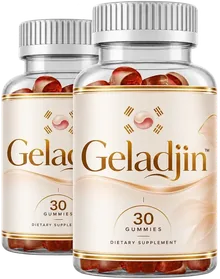
2 bottles
60 gummies · 60 days at 1 a day
$79per bottle
- Total
- $158
- Per day
- $2.63
- Shipping
- Shipping added at checkout (amount not published)
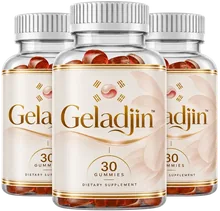
3 bottles
90 gummies · 90 days at 1 a day
$69per bottle
- Total
- $207
- Per day
- $2.30
- Shipping
- Free U.S. shipping
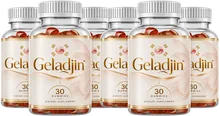
6 bottles
180 gummies · 180 days at 1 a day
$49per bottle
- Total
- $294
- Per day
- $1.63
- Shipping
- Free shipping reported
- Ask first if you take medicineDiabetes medicine or insulin, a water pill, digoxin, or low potassium: apple cider vinegar is on the label, and MedlinePlus lists these.
- Pick a package30 gummies a bottle, one a day by the label. 3 bottles ship free in the U.S., 6 bottles ship free as reported, and shipping on 2 is added at checkout.
- Read the totalCheck the address bar, the retailer name, the total and any add-on box. Keep the receipt.
- Mark day 60Plan on 60 days from the purchase date: we could not confirm when the seller starts counting. Keep the tracking email.


 Badges supplied by the seller, shown as supplied. None names a certifying body, lab or number; what each one would need to mean is on the badges page.
 Payment logos come from the seller's pack; we could not confirm which methods the checkout accepts. Order links are marked sponsored. If you take diabetes medicine, insulin, a water pill or digoxin, ask your doctor first.
What is the evidence ladder for Geladjin Gummies?
Think of evidence as a ladder with the strongest rung on top. The table places each source we used, and shows that none reaches the rung of a study on this product.
| Rung | Source | What it says | Does it test the gummy? |
|---|---|---|---|
| Review of vinegar uses | MedlinePlus2 | No good scientific evidence for obesity, diabetes, athletic performance or kidney stones; not enough reliable information | No |
| Review of supplement evidence | Operation Supplement Safety3 | Low quality evidence, small studies, contents vary | No |
| Review of ginger uses | NCCIH4 | Some uses studied, poor quality knee research, no doses stated | No |
| A trial that was retracted | BMJ Group notice5 | One vinegar trial withdrawn | No |
| Rules on claims | FTC guidance6 | Claims need competent and reliable evidence | Not a study |
The top of an actual ladder for a product claim would be a randomized controlled trial of the product, or something essentially equivalent6. We found none for Geladjin Gummies, so the gummy sits below the first rung.
What happened to the retracted vinegar trial?
BMJ Group retracted a March 2024 trial of apple cider vinegar and weight in adolescents and young adults, with a notice dated September 23, 2025, and said its results should no longer be used5.
The reasons included concerns about the statistical analysis, implausible statistical values, the reliability of the raw data, inadequate reporting of methods and no prospective trial registration. Statisticians could not replicate the results5. This was a widely quoted trial, so its removal matters.
Say it plainly and no further: one study was retracted. That does not show vinegar is harmful, and it does not show vinegar is useless. It also says nothing about Geladjin Gummies either way. We tell the full story on our retracted study page.
| Amount | Acetic acid (about) |
|---|---|
| 1 gummy | 12.5 mg |
| 1 teaspoon of 5% vinegar | 250 mg |
| 1 tablespoon of 5% vinegar | 750 mg |
An amount comparison only. We could not confirm how the label's percentage was measured, and it is not a dose.
What would new evidence look like?
New evidence would be a registered trial of Geladjin Gummies, or of a product with the same formula, with results anyone can read and replicate. It would name who ran it, how many people took part and what was measured, and it would be posted before the result was known.
If the seller or anyone else publishes such a study, we will read it and update this page. Until then, the accurate summary has three short parts: no study of the product, limited research on the ingredients and no promises we can repeat.
What do supplement contents have to do with the science?
Studies of vinegar only help a reader if the product in the jar matches the product in the study. For supplements, that is hard to check.
Operation Supplement Safety says labels do not consistently report ingredient amounts, and describes two studies of apple cider vinegar tablets that found a range of contents and acidity up to 10 times household vinegar. It adds that without lab testing, the actual ingredients and amounts are unknown3. MedlinePlus says standardized products may have 4% to 8% acetic acid and composition varies2.
Those studies were of tablets, not gummies. The lesson is about method, not about Geladjin: a number on a label is a claim until someone measures it, and we found no published measurement for this gummy. Our benefits page shows how this connects to the claims people search for.
Why do we keep saying "on its own"?
Because an ingredient studied alone behaves differently, on paper at least, from a finished product with many other parts. The label lists eight other ingredients besides the two with amounts: pectin, cane sugar, tapioca syrup, water, citric acid, sodium citrate, natural flavors and natural colors.
A study of vinegar as a liquid says nothing about how a pectin gummy is made, what its acetic acid level is or how much of the 250 mg is actual acid. Our math gives about 12.5 mg of acetic acid per gummy if the label's 5% describes the 250 mg, an estimate we could not confirm, and about 750 mg for a tablespoon of 5% household vinegar. That gap is one more reason the household-vinegar research does not carry over. It is not a dose and we do not present it as one.
The same goes for ginger. A study that used a ginger root supplement says little about a gummy with 1 mg of dry extract, and the NCCIH page gives no study doses to line up4.
How can you judge a research claim yourself?
Ask the same five questions of any study you meet, in an ad or a news story. They take two minutes.
- Did it study this product, or only an ingredient?
- How many people took part, and for how long?
- Was it registered before it started, and has it been replicated?
- Who paid for it, and who ran it?
- Has it been retracted or corrected?
The last question is not a trick, and it is worth asking even of studies that sound impressive. The retracted trial shows that even a published study can be withdrawn. FTC guidance adds that testimonials cannot stand in for scientific evidence of a health claim6. We also remind readers that the FTC bans fake and bought reviews7.
Who should ask a doctor before using Geladjin Gummies?
Science aside, safety comes first. If you take diabetes medicine or insulin, a diuretic or digoxin, or you have low potassium, ask your doctor before using Geladjin Gummies.
MedlinePlus says apple cider vinegar might lower blood sugar and potassium and lists interactions with those medicines2. It says not to use apple cider vinegar if you have low potassium2. Never start, change or stop a medicine because of this page.
If you are pregnant, nursing, under 18 or have a known medical condition, the label says to consult a physician. MedlinePlus says there is not enough reliable information on medicinal use during pregnancy or breastfeeding2, and NCCIH says to consult your provider about ginger in pregnancy4.
Research on an ingredient is not research on this gummy. If someone offers you a study, send us the citation at [email protected] and we will read it.
Frequently asked questions
Is there a Geladjin clinical study?
We found no Geladjin clinical study, and the label cites none. The sources we read describe vinegar and ginger on their own, not the gummy.
Is Geladjin Gummies supported by independent research?
No independent research on Geladjin Gummies turned up in our search. MedlinePlus says there is no good scientific evidence for several uses of apple cider vinegar2.
What do apple cider vinegar studies say, and do they apply to Geladjin?
Operation Supplement Safety says the evidence for apple cider vinegar is of low quality and studies are small3. Those studies did not test Geladjin Gummies, so they cannot tell you how it behaves.
Where does the Geladjin evidence stand after the BMJ retraction?
BMJ Group retracted one apple cider vinegar trial in 2025 and said its results should not be used5. That removes one study from the pile; it says nothing about Geladjin directly.
Can a Geladjin clinical study claim be trusted without the study itself?
No. Health claims need competent and reliable scientific evidence, and testimonials cannot substitute for it6. Ask to see the study.
Sources for this page
D1 = the Geladjin sales page named in the owner pack (it did not load for us). D2 = an independent affiliate page that read the order page. S = U.S. government and NIH sources. Label facts come from the seller's label photo, which we read ourselves.
- D2 Independent affiliate information page that read the Geladjin order page (name withheld). Independent affiliate page (read November 28, 2026). (name withheld)
- S1 Apple cider vinegar (MedlinePlus herbs and supplements). MedlinePlus, U.S. National Library of Medicine. medlineplus.gov/druginfo/natural/816.html
- S3 Apple cider vinegar in dietary supplements (Operation Supplement Safety). Operation Supplement Safety (U.S. Department of Defense). www.opss.org/article/apple-cider-vinegar-dietary-supplements
- S2 Ginger (NCCIH). National Center for Complementary and Integrative Health (NIH). www.nccih.nih.gov/health/ginger
- S4 BMJ Group retracts trial on apple cider vinegar and weight loss (September 2025). BMJ Group (via EurekAlert news release). www.eurekalert.org/news-releases/1099052
- S12 Health Products Compliance Guidance. Federal Trade Commission. www.ftc.gov/business-guidance/resources/health-products-compliance-guidance
- S11 FTC final rule banning fake reviews and testimonials (August 2024). Federal Trade Commission. www.ftc.gov/news-events/news/press-releases/2024/08/federal-trade-commission-announces-final-rule-banning-fake-reviews-testimonials
Last updated November 28, 2026. Facts come from the label photo we read, the owner pack, an affiliate page that read the order page and the public U.S. sources above; prices were checked November 28, 2026. Spotted an error? Email [email protected].