On this page 10 sections
- What does the label say about Geladjin weight loss?
- Try the claim sorter
- What do the sources say about apple cider vinegar and weight?
- What happened to the retracted apple cider vinegar trial?
- Why do weight loss claims spread so easily?
- What do the label's calories and sugar add up to?
- How should you read weight loss claims for any supplement?
- What does the gummy's form change?
- What should you do if you want to talk about weight?
- FAQ
The label on Geladjin Gummies makes no weight claim, so a search for Geladjin weight loss leads to wording that did not come from the bottle. This page covers what the label says, what MedlinePlus and Operation Supplement Safety say about apple cider vinegar and weight, and what the retraction of one widely quoted trial means.
We found no study of Geladjin Gummies. Nothing below says the gummy helps with weight, and nothing says it does not.
What does the label say about Geladjin weight loss?
Nothing. The label we read carries no weight claim, no "supports" wording and no promise of any result.
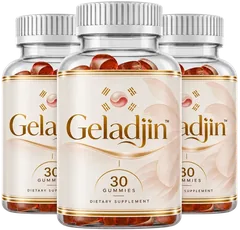
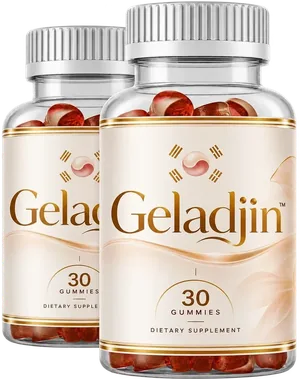
It prints "Geladjin", "30 GUMMIES" and "DIETARY SUPPLEMENT", then the Supplement Facts: 250 mg of apple cider vinegar (5% acetic acid), 1 mg of ginger dry extract, 10 calories and 3 g of added sugars per gummy. The directions say to take one gummy daily with an 8 oz glass of water. The only statement about effects is the FDA disclaimer, which says the statements have not been evaluated.
The owner pack tells us to confirm claims against the bottle only. On this topic the bottle is silent. So any Geladjin weight loss claim you see belongs to an ad, a video or a search snippet, and you should ask where it appears on the label. Our label guide reads the whole wrap.
Try the claim sorter
Test yourself on what is and is not printed on the bottle. This is the claim sorter, and it uses the label as the answer key.
ToolClaim sorter: on the bottle, or not?
Seven things people say about Geladjin. Tap whether each one is printed on the bottle we read. The answers show what the label says.
- 30 gummies, dietary supplement
- 250 mg apple cider vinegar per gummy
- Burns belly fat
- Controls blood sugar
- Curbs appetite and cravings
- Manufactured in the USA with globally sourced ingredients
- Detox and cleanse
Tap an answer for each claim.
This tool needs JavaScript turned on.
| Item | What the sources say |
|---|---|
| Vinegar for weight or blood sugar | Not enough reliable evidence (MedlinePlus) |
| Ginger | Some evidence for nausea of pregnancy; no doses given for comparison (NCCIH) |
| Excess added sugar | Linked to weight gain, type 2 diabetes and heart disease (CDC, Harvard) |
| A 2024 vinegar trial | Retracted September 23, 2025 (BMJ Group) |
| Geladjin Gummies | No study found |
Research covers each ingredient alone, usually for other uses and at other amounts.
What do the sources say about apple cider vinegar and weight?
The sources are not encouraging, and they are cautious. MedlinePlus says there is no good scientific evidence for obesity use of apple cider vinegar, and not enough reliable information to say whether it might be helpful1.
Operation Supplement Safety says apple cider vinegar is marketed for appetite, weight, blood sugar, cholesterol, digestion and immunity, that the evidence for those uses is of low quality and that the studies are small2. Both sources describe vinegar as a food, liquid or supplement in general, usually at other amounts than a gummy, and neither studied Geladjin Gummies.
Notice the limits of that summary. It does not say vinegar is harmful, and it does not say it is useless. It says the evidence is poor. The Federal Trade Commission adds that health claims need competent and reliable scientific evidence, and that testimonials cannot substitute for it3. Read more on our science page.
Order
Geladjin Gummies packages and prices
Prices reported for the sales page, which match the owner pack, when we checked on November 28, 2026; confirm at the live checkout. Order links here open the sales page named in the owner pack; it did not load for us, so check it before you pay.
Pick a package to see the total, cost per day and the day-60 date.
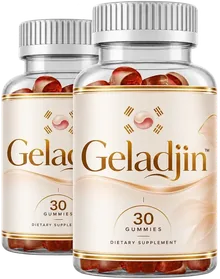
2 bottles
60 gummies · 60 days at 1 a day
$79per bottle
- Total
- $158
- Per day
- $2.63
- Shipping
- Shipping added at checkout (amount not published)
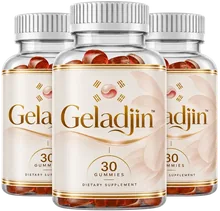
3 bottles
90 gummies · 90 days at 1 a day
$69per bottle
- Total
- $207
- Per day
- $2.30
- Shipping
- Free U.S. shipping
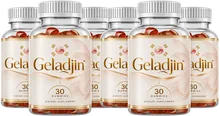
6 bottles
180 gummies · 180 days at 1 a day
$49per bottle
- Total
- $294
- Per day
- $1.63
- Shipping
- Free shipping reported
- Ask first if you take medicineDiabetes medicine or insulin, a water pill, digoxin, or low potassium: apple cider vinegar is on the label, and MedlinePlus lists these.
- Pick a package30 gummies a bottle, one a day by the label. 3 bottles ship free in the U.S., 6 bottles ship free as reported, and shipping on 2 is added at checkout.
- Read the totalCheck the address bar, the retailer name, the total and any add-on box. Keep the receipt.
- Mark day 60Plan on 60 days from the purchase date: we could not confirm when the seller starts counting. Keep the tracking email.


 Badges supplied by the seller, shown as supplied. None names a certifying body, lab or number; what each one would need to mean is on the badges page.
 Payment logos come from the seller's pack; we could not confirm which methods the checkout accepts. Order links are marked sponsored. If you take diabetes medicine, insulin, a water pill or digoxin, ask your doctor first.
What happened to the retracted apple cider vinegar trial?
BMJ Group retracted a March 2024 apple cider vinegar weight-loss trial, with a notice dated September 23, 2025. The trial involved Lebanese adolescents and young adults, and BMJ said its results should no longer be used4.
The reasons given were concerns about the statistical analysis, implausible statistical values, the reliability of the raw data, inadequate reporting of methods and no prospective trial registration. Statisticians could not replicate the results4.
It was a widely quoted trial, so many ads and articles cited it. Anything that still leans on it rests on a study its publisher has withdrawn. That says nothing for or against Geladjin Gummies. For the full account, see our retracted study page.
Why do weight loss claims spread so easily?
They spread because the topic is personal, the claims are simple and the proof is hard to check. A single bold sentence travels faster than a careful caveat.
A claim also gains weight each time it is repeated, even if the original source was weak or has since been withdrawn. The retracted trial is a clear example: it was quoted widely, and its removal did not reach every page that cited it. That is why we name the retraction directly and why we trace each claim to its source.
Search results add another layer. A phrase typed into a search box is a question, not a fact. When a page repeats the phrase as if it were a label statement, the reader may think the bottle said it. We use the searcher's words only as a label for the question, such as "Geladjin weight loss", and then we answer with what the label and the sources actually say.
Finally, ingredient research is often presented as product research. A study of vinegar as a liquid is not a study of a pectin gummy that holds 250 mg of vinegar, and we found no study of the gummy at all.
What do the label's calories and sugar add up to?
They add up to a small amount that still counts. The label says one gummy has 10 calories and 3 g of added sugars, which is 6% of the 50 g Daily Value.
Our math puts those 3 g at 8.3% of the 36 g a day the American Heart Association suggests for most men and 12.5% of the 24 g it suggests for most women. The Harvard Nutrition Source says the Dietary Guidelines advise limiting added sugars to less than 10% of calories, about 50 g on a 2,000 calorie diet5. The CDC says that consuming too many added sugars can contribute to weight gain and obesity, type 2 diabetes and heart disease6.
| Item | Per gummy (label) | Per 30-gummy bottle (our math) |
|---|---|---|
| Calories | 10 | 300 |
| Added sugars | 3 g | 90 g |
| Percent of the 50 g Daily Value | 6% | 180% if eaten all at once (not how it is meant to be used) |
The jar is meant to last 30 days at one a day, so the daily figure is the one that matters. Our added sugar page shows the daily math, and Geladjin Gummies is not sugar-free or low-sugar.
How should you read weight loss claims for any supplement?
Read them as claims to be proven, not facts. The questions are the same for any product, and they take a minute.
- Is the claim printed on the label, or only in an ad?
- Does a source name the product itself, or just an ingredient?
- Is the study cited still standing, and was it registered before it began?
- Does the proof rely on photos, stories or star ratings, which cannot show cause?
- Does the seller describe a time frame? We never repeat one, since none can be promised.
The FTC bans fake and bought reviews and testimonials7, and a before-and-after photo is a testimonial. We publish none for Geladjin Gummies and could not verify any we saw. For what readers can expect, see our results page.
What does the gummy's form change?
The form changes the sugar and the setup, not the evidence. A gummy has pectin, cane sugar and tapioca syrup to hold it together, which is where the 3 g of added sugars comes from. The label lists the other ingredients as pectin, cane sugar, tapioca syrup, water, citric acid, sodium citrate, natural flavors and natural colors.
Studies on vinegar as a liquid or tablet do not carry over to this form, and the label does not say how its 5% acetic acid figure was measured. Our math gives about 12.5 mg of acetic acid per gummy if the 5% describes the 250 mg of vinegar, which is an estimate we could not confirm. It is not a dose, and we do not compare it with any study.
What should you do if you want to talk about weight?
Talk to a doctor or dietitian. They can look at your health, your medicines and your goals, which a supplement page cannot do.
A supplement is not a substitute for medical care. If you decide to try Geladjin Gummies anyway, follow the label: one gummy daily, do not exceed the recommended dose, and keep out of reach of children.
Who should ask a doctor before using Geladjin Gummies?
Anyone on certain medicines or with certain conditions should ask first. If you take diabetes medicine or insulin, a diuretic or digoxin, or you have low potassium, ask your doctor before using Geladjin Gummies.
MedlinePlus says apple cider vinegar might lower blood sugar and potassium and lists interactions with those medicines1. It says not to use apple cider vinegar if you have low potassium1. Never start, change or stop a medicine because of this page.
If you are pregnant, nursing, under 18 or have a known medical condition, the label says to consult a physician.
Weight is a personal health topic. This website is not medical advice, and we cannot see your history. Questions about this page go to [email protected].
Frequently asked questions
Does Geladjin cause weight loss?
The label makes no such claim, and we found no study of Geladjin Gummies. MedlinePlus says there is no good scientific evidence for obesity use of apple cider vinegar1.
Does Geladjin help you lose weight?
We cannot say it does or does not, because no study of the product exists that we could find. The label is silent on weight, and the FTC says claims need competent and reliable scientific evidence3.
Do apple cider vinegar gummies weight loss claims hold up for Geladjin?
Can Geladjin before and after pictures prove weight claims?
We publish none and could not verify any. Photos are testimonials, and the FTC bans fake and bought reviews and testimonials7.
How do Geladjin calories and sugar relate to weight?
One gummy has 10 calories and 3 g of added sugars, which counts toward your daily added sugar5. It is a small amount, and we make no claim about what it does for weight.
Sources for this page
D1 = the Geladjin sales page named in the owner pack (it did not load for us). D2 = an independent affiliate page that read the order page. S = U.S. government and NIH sources. Label facts come from the seller's label photo, which we read ourselves.
- S1 Apple cider vinegar (MedlinePlus herbs and supplements). MedlinePlus, U.S. National Library of Medicine. medlineplus.gov/druginfo/natural/816.html
- S3 Apple cider vinegar in dietary supplements (Operation Supplement Safety). Operation Supplement Safety (U.S. Department of Defense). www.opss.org/article/apple-cider-vinegar-dietary-supplements
- S12 Health Products Compliance Guidance. Federal Trade Commission. www.ftc.gov/business-guidance/resources/health-products-compliance-guidance
- S4 BMJ Group retracts trial on apple cider vinegar and weight loss (September 2025). BMJ Group (via EurekAlert news release). www.eurekalert.org/news-releases/1099052
- S5 Added Sugar (The Nutrition Source, Harvard T.H. Chan School of Public Health). Harvard T.H. Chan School of Public Health. nutritionsource.hsph.harvard.edu/what-should-you-eat/added-sugar
- S6 Get the Facts: Added Sugars (CDC). Centers for Disease Control and Prevention. www.cdc.gov/nutrition/php/data-research/added-sugars.html
- S11 FTC final rule banning fake reviews and testimonials (August 2024). Federal Trade Commission. www.ftc.gov/news-events/news/press-releases/2024/08/federal-trade-commission-announces-final-rule-banning-fake-reviews-testimonials
Last updated November 28, 2026. Facts come from the label photo we read, the owner pack, an affiliate page that read the order page and the public U.S. sources above; prices were checked November 28, 2026. Spotted an error? Email [email protected].